ELEONORA LUTSKY:
“STAGE, AUDIENCE, ADRENALINE IS MY FORMULA OF LIFE”
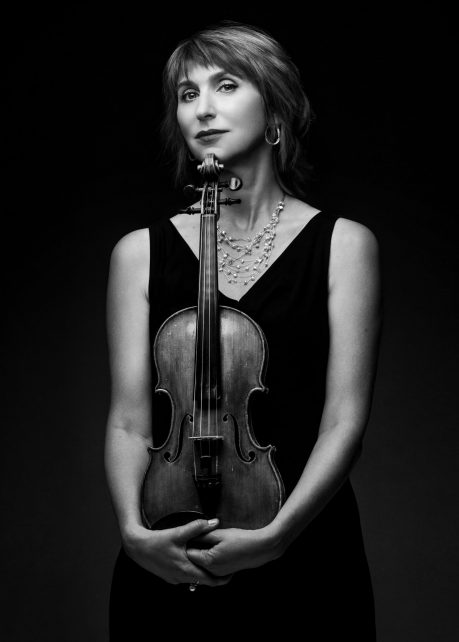
During the concert, the musicians communicate with the listeners in a common language that does not require words or translation. Live placer of musical passages — the trademark of the violinist. But the more expressive this sound, the more interesting it is to continue acquaintance with the performer: his or her history, motives, feelings, life choices and world view. And here you cannot do without words.
In this interview Eleonora Lutsky talks about the happiness of working with the legendary Zubin Meta, about higher mathematics for musicians, the perception of dreams, dances and tears of listeners at concerts and about her ability in a difficult situation «to turn lemons into lemonade».
— Eleonora, in many languages there is a figurative expression «play the first violin», that is, to be a leader. How close is this role to you not only in your profession, but also in life?
Eleonora Lutsky: — Surely close! I always want to start something new, start my own projects, and lead the main role in every situation. I’ve never been a second since I was a kid. By the way, when I joined the Israel Philharmonic Orchestra, the only place I had was in the group of second violins. But I guess you can’t run away from yourself.
I went through two more contests to join the first group of violins.
At school age, I adored the stage and the solemn mood of concerts, when I performed smartly dressed, white bows in my hair. The audience applauds — I feel like a soloist. At the same time, I did not like practicing, preparing for music lessons. So, my teacher was very surprised and told my parents: “It’s incredible, she comes to class unprepared, but when she comes out on stage, she plays everything perfectly, and I don’t know how!”
Since then, the audience, the stage, the white bows, the adrenaline — that’s the formula of life for me. In this sense, today little has changed, only the bows remained in childhood.
”My teacher was very surprised and told my parents: “It's incredible, she comes to class unprepared, but when she comes out on stage, she plays everything perfectly, and I don't know how!”
— Who taught you to listen to music?
— I grew up in a family with strong musical genes. Even though my parents were engineers, classical music was always playing in the background. And although we lived in a small, but today infamous to the world town, Severodonetsk, dad managed to collect a large music library.
I listened to the best classical performances. Later my parents started taking me to symphony concerts, to the Opera. As a child, I learned to yawn in concert halls without opening my mouth, but this habit remained for life.
— And what was the determining factor in the choice of profession?
— Ambitions started to show. I was supposed to participate in the competition of performers. So, I thought, «I’ll show everyone!» I started working at full capacity. Apparently, the ambitions of the first violin then manifested themselves in me. Winning the competition at the age of 14 strengthened my self-confidence. Later, I received a higher academic education at one of the best music schools in the world — the Leningrad Conservatory.
Then this educational institute was considered as strong as the Juilliard School and the Manhattan School of Music (New York, USA) in terms of the level of graduate training. A lot has changed today, but in the music world they know that we, musicians from the former Soviet Union, are in great competition with our Western colleagues. And this, I note, is healthy competition.
— Academic training tends to place the musician in a rather hermetic world, separated from other contemporary musical movements. How is it that your repertoire has no rigid genre boundaries?
— Throughout my life, I have been drawn into different genres. I like to do something experimental, non-standard. When I arrived in Israel, quite by accident — life is made up of such little zigzags — two weeks after the plane landed, I was accepted to the Jerusalem Radio and TV Symphony Orchestra.
"Throughout my life, I have been drawn into different genres. I like to do something experimental, non-standard."
At that time, I was an unknown girl from St. Petersburg in the Israeli musical environment and was the sixteenth violinist in the orchestra. It so happened that the soloist of “The 21st century” ensemble broke her arm. Its director turned to me and asked me to replace her urgently. Thus, for the next 11 years I was the concertmaster of the contemporary music ensemble.
— Was this an unexpected career start for you?
— Yes, we played experimental music, which can be compared to higher mathematics for musicians. Among the most famous composers, for example, Schnittke. Works by authors of the late 20th century and our contemporaries were performed — György Ligeti, Thomas Ades.
It is worth saying that in Israel there is a very narrow audience of contemporary music concerts. This is not Moscow, not St. Petersburg and not New York. However, they had their listeners. Sometimes it’s interesting, sometimes boring, but there were also real masterpieces. One of the cool projects, like when we performed a sex opera with a Finnish producer in collaboration with the Finnish National Opera. The music was brilliant, but things that were so strange and “obscene” for the late 1990s were happening on stage so that a part of the audience was leaving the concert hall in bewilderment.
— According to contemporary composer Anton Batagov, music is “the best means to prolong the state of consciousness beyond duality.” What does music mean to you?
— Often professional musicians, after years of listening to themselves and endless practicing, begin to lose the feeling of immediate joy from music and rarely go to music concerts as listeners. Nevertheless, yesterday I listened to the opera «Aida» by Verdi. This ingenious music brought me back to a state where I can perceive it as “just a person”. I remembered how powerfully music can affect feelings. Sometimes at concerts, in pauses, I look at the faces of the audience in the hall: one is already sleeping, the other is busy looking at the phone screen, and suddenly I notice a person whose eyes are shining. One day I noticed a soldier with tears running down his face when Chopin’s piano prelude solo was playing. At that moment, I thought, “That’s why we’re here.” Despite the fact that professionals are usually more concerned about whether all passages sounded clean- it’s not about technically flawless performance, it’s about making the soldier in the hall cry.
— The difference in attitudes towards music between professionals and listeners sounds paradoxical.
— The skill of a professional musician is to reproduce this miracle countless times. There is a famous story about Chaliapin, who played the scene of Boris Godunov’s madness in such a way that the audience were in ecstasy. He could turn at any second and show his tongue to the fireman standing backstage. He could achieve the same effect over and over again with his art.
"Despite the fact that professionals are usually more concerned about whether all passages sounded clean. It's not about technically flawless"
— Are you able to switch just as easily?
— It’s hard for me. When I perform the Brahms trio, and emotions overwhelm me, I can hardly show my tongue to like Chaliapin to anyone.
— You mentioned a listener who fell asleep during the concert. How do you feel about such a reaction to your art? Suppose someone you know comes to you after the concert and says that he fell asleep right in the hall and had a wonderful dream.
— It’s not very pleasant to hear, but I would probably joke back that I’m happy to be of service to this person. Healthy sleep is good.
— You played in an orchestra conducted by Zubin Mehta. What does this experience mean to you?
— He directed the orchestra for 50 years, a Guinness record. It was Zubin Mehta who formed the Israel Philharmonic Orchestra as an outstanding musical group. Thanks to him, our orchestra has gained such a reputation, a special sound, a spark. Zubin Meta gave the orchestra this spark. His ear was aimed at finding the individuality of the performance, a beautiful, artistic sound while listening to musicians at the entrance auditions. This remains with us to this very day. Zubin Mehta — a Man with a capital letter, Der Mensch, as they say in Yiddish. Zubin Mehta was born in remote India, but his soul has become attached to our country and people. In the worst days of the wars, he dropped everything and flew here.
I remember his public speeches, the sincerity and timeliness of which brought tears to my eyes.
In professional terms, he is a true master of both large musical canvases and light bright pieces. Thanks to him, we were spoiled for performances with the best soloists in the world. Everyone dreamed of playing with him, under his conducting baton. Everyone wanted to have the line on their resume: «… under the direction of Zubin Mehta.»
"He directed the orchestra for 50 years, a Guinness record. It was Zubin Mehta who formed the Israel Philharmonic Orchestra as an outstanding musical group."
Zubin Mehta studied in Vienna, and thanks to him I first comprehended the work of Bruckner, and Mahler. Mehta was able to convey to us, musicians, his interpretation of the work, and the philosophical thought of the composer. This is a special talent based on wisdom and experience.
I remember his last concert with the IPO, when we played one of Mahler’s symphonies. There was a pause at the end of the symphony: he held his hands up, tears ran down his cheeks… It’s a pity that the era of Zubin Mehta is over for the orchestra. But for me, as a musician, it is absolute happiness to have worked with this brilliant conductor for almost 20 years.
— What concert was the most grandiose in your life?
— I can’t name just one performance. When I worked as an assistant concertmaster in the Jerusalem Orchestra of the Israel Broadcasting Authority, I felt an incredible sense of joy during the performance of a festive concert in Germany with the Bavarian Radio Orchestra conducted by maestro Lorin Maazel. In the late 90s, leading musicians in the Jerusalem Orchestra were given Italian instruments from private collection, I played the Sibelius Violin Concerto with an orchestra with a wonderful Italian violin. That was a unique experience.
I also have vivid, strong impressions of performing in Los Angeles, already as part of the Philharmonic Orchestra, where we played on tour with another brilliant conductor, the American Lorin Maazel. We performed Mendelssohn’s Italian Symphony. And when we finished playing, I thought: “Wow, that was like supersonic flight – in one breath!”
One of the great performances, which I also remember, was the concert in Buenos Aires, when it was decided to make the concert in the park open to the public. An audience of thousands gathered. During the concert, it started to rain, a strong thunderstorm. This heightened the emotional intensity. It was clear that Zubin was enjoying this natural environment. At the end of the concert, we performed the Argentine tango. Suddenly the elderly couples spontaneously began to dance! To see how these people move elegantly, people who tango runs in their blood, was delightful and touching to tears.
— All the world’s musicians have experienced an unprecedented period during the pandemic, with concerts played without an audience or canceled. How did you manage to get through this time?
— You know, there is a famous tale about two frogs that got into a jug of cream, and one of them began to sink, while the other whipped the butter and got out. Likewise, after sitting at home for a while, I first practiced scales. I became utterly sad. I decided that I needed to do something else. I sewed four dresses, learned to cut and sew from scratch. I felt it’s still not mine. Concerts could not be held indoors, but outdoors. I thought, why not organize concerts in an open-air winery? Israel makes amazing wine, there are many small wineries in the country. This idea brought together everything I love: wine, music and nature. As a result, in a duet with a pianist Maria Nikitin, we played a program that included both classical music, compositions by Astor Piazzolla, and Brazilian bossa nova. We talked about works and musical instruments, and the audience was drinking wine and enjoying. That was amazing! Many longed for art during the quarantine and were happy to go to concerts again. Then I organized another project in the winery, but with a harp. Together with the first harpist of the Israel Philharmonic Orchestra, my colleague Yulia Rovinskaya, created a very interesting program.
Besides, I remembered that, in addition to the violin, I also love foreign languages. I know Russian, Ukrainian, English, Spanish and Hebrew. In my free time I began to teach Hebrew to foreigners. It was a useful experience, an opportunity to try myself in a new field, implementation in new formats. The absence of halls and the public — it was hard.
The pandemic has shown that without performances, we, as musicians, have to live as if in conditions of lack of air. At the same time, I became convinced that my approach of turning lemons into lemonade, no matter what life has to offer, was working successfully.
"I became convinced that my approach of turning lemons into lemonade, no matter what life has to offer, was working successfully."
— At the beginning of our conversation, you mentioned your own projects. Please tell us more about them.
— For a long time we have been performing together with colleagues in different ensembles at chamber concerts: a duet, a trio, a quartet. We usually perform what the audience of classical music prefers to listen to. We always prepare a program for a specific event. For example, if we play a concert at the Austrian embassy, then the program, of course, is somehow connected with the names of famous Austrian composers and conveys the spirit of musical Vienna.
In general, people like to listen to what they already know. Therefore, most often we perform the classics. Sometimes jazz classics – Gershwin, Ellington, Armstrong. As well as music from films. For example, Ennio Morricone, John Williams are geniuses in their genre.
— Do you have your own criteria for flawless performance?
— Oh, this is very hard. When I play, I am very critical of myself. It happens that after a concert, at night I analyze why I played this or that passage in such a way, although it could have been in a different way. I think that a performer who is always pleased with himself is a problem. I am used to constantly improving my skills. I can praise myself only when I see shining eyes, inspired faces, lively emotions in the hall. That’s why we are on stage.
Text author: Maria Trokay


